The Direct Menu Optimization Blueprint: How Pizzerias Turn Online Browsers Into Instant Orders
The Direct Menu Optimization Blueprint: How Pizzerias Turn Online Browsers Into Instant Orders
Most pizzeria websites leak money the second a customer lands on the ordering page.
A customer visits your site hungry, ready to spend $35 to $50. Instead of seeing food, they get an endless scroll, a clunky multi-page navigation tree, or worse, a static PDF menu they have to pinch and zoom on a phone screen.
Online ordering is not a digital filing cabinet for your kitchen inventory. It is an e-commerce checkout funnel. The job of your digital menu is to push hungry browsers into adding an item to their cart in under thirty seconds.
If your online sales are sluggish or your conversion rate is weak, you do not need an expensive marketing agency. You need to fix three operational levers on your digital menu: item hierarchy, photography, and menu copy.
Step 1: Put Your Top Sellers at the Absolute Top
The biggest mistake independent operators make is organizing their online ordering page alphabetically or mimicking their paper dine-in menu.
When someone opens your online ordering system on a Friday night, they are not reading a novel. They want dinner. Every extra scroll, category tap, or search bar query introduces friction—and friction causes abandoned carts.
Pull Your Sales Data First Before touching your menu layout, open your Point of Sale (POS) backend—whether you use Toast, Clover, or Square. Run a product mix (PMIX) or sales report covering the last 30 to 180 days.
Identify your top five highest-volume items. In 90% of pizza shops, the vast majority of gross revenue comes from a tight cluster of items: a standard Large Cheese, a Pepperoni, one signature specialty pie (like a Meat Lovers or Hot Honey Pepperoni), bone-in wings, and garlic knots.
Build a "Most Popular / Top Sellers" Gateway Category Do not force a customer to tap "Pizza," then select "Specialty Pizzas," then scroll past eight other pies just to find the pepperoni pizza you sell 400 of every week.
Create a dedicated category positioned at the absolute top of your online menu titled "Most Popular Items" or "House Favorites." Drop your top 4 to 6 bestsellers directly inside it.
The Logic: This acts as a frictionless gateway. You get an item into the customer’s cart immediately.
The Upsell Engine: Modern online ordering platforms and POS software excel at automated upselling. Once the customer clicks your top-selling pie, the checkout software can automatically prompt them: "Add a 2oz Side of House Ranch?" or "Add Garlic Knots for $5.99?"
Get the main item into the cart first. Let the software handle the margin add-ons during the checkout flow.
Step 2: Ditch Stock and AI Images for Real Food Photography
Customers eat with their eyes, especially online. When a customer orders online, they are buying a visual expectation.
However, many independent shops either have no photos at all, or they make the fatal mistake of pulling generic stock photos or generating fake food with AI tools.
AI-generated food images look plastic, uncanny, and deceptive. When a customer receives a pie that looks nothing like the computer-generated graphic on your website, they do not order again. They feel cheated.
You do not need to hire a $2,500 commercial food photographer. You can shoot high-converting, mouth-watering assets using tools already inside your kitchen.
The Equipment: Use What You Have
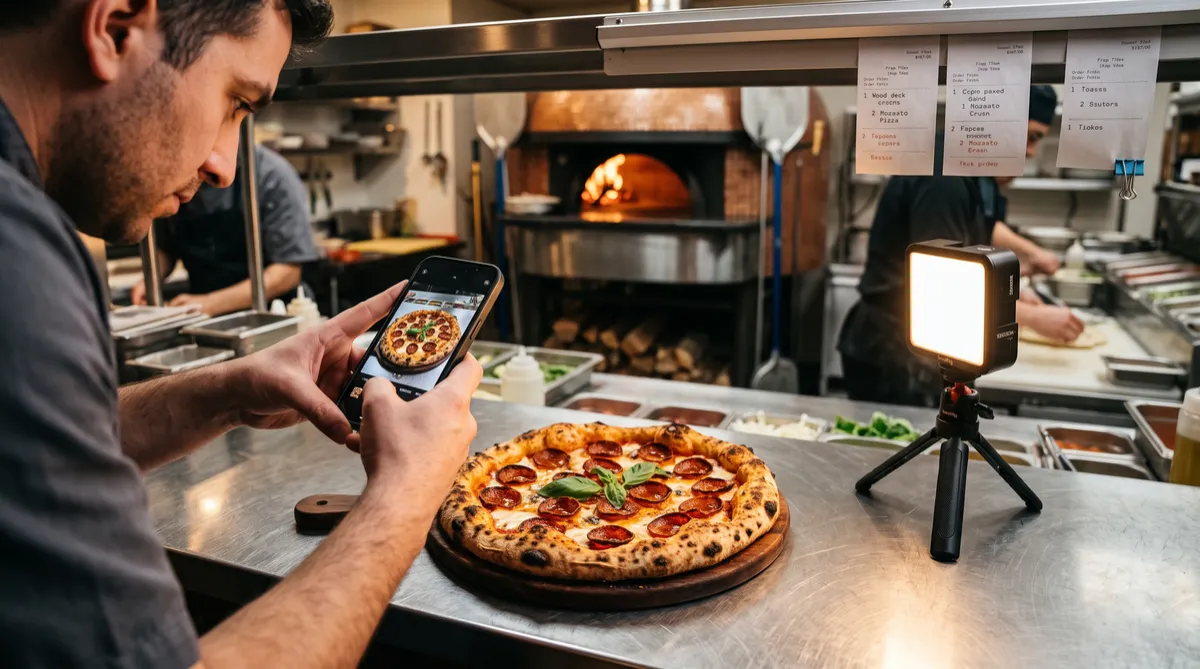
You need a smartphone purchased within the last two to three years. If you are running an older phone with a scuffed lens, hand the checklist to one of your high school or college-aged prep cooks or cashiers. Their smartphones have multi-lens 4K camera arrays, and they intuitively know how to frame a shot.
The Golden Lighting Rule
Fluorescent overhead kitchen lights make pizza look pale, greasy, and unappealing.
Invest $25 on Amazon: Buy an inexpensive, handheld bi-color LED video light panel.
Diffused, Angled Light: Place the light at a 45-degree angle slightly to the side or behind the food—never blast it directly straight-on like a harsh camera flash. This highlights the caramelization on the crust, the melted sheen of the mozzarella, and the cupping of the pepperoni without creating dead black shadows.
Clean the Lens: Kitchen environments are full of aerosolized grease and flour dust. Wipe your smartphone camera lens with a clean microfiber cloth before every single shot. A greasy lens ruins sharp focus.
The Workflow Checklist
Do not attempt to bake your entire menu in one chaotic afternoon.
Print your full POS menu inventory onto a single sheet of paper. Tape it next to the expo station or cut table. As items are naturally ordered fresh during a regular prep shift or early dinner rush, set the box or plate under your dedicated lighting corner.
Snap three high-resolution photos at a 45-degree angle (the exact perspective of someone sitting down to eat), check the item off your list, and send the food out the door. Within two weeks, you will have authentic, high-resolution photos for every single item on your menu without wasting a dime of food inventory.
Step 3: Write Sensory Item Descriptions (Using AI as Your Copywriter)
A menu item with no description or a lazy ingredient list leaves money on the table.
Too many menus feature entries like:
Margherita Pizza: Dough, sauce, fresh mozzarella, basil.
That is an ingredient list, not a description. It creates zero appetite appeal, conveys zero craft, and fails to justify premium pricing.
If you struggle with writing or do not have the time to sit down and compose marketing copy, generative AI is your personal menu engineer. You do not ask AI to invent facts; you feed it the specific raw details of your ingredients and let it structure the sensory language.
What Details to Feed the AI
To get descriptive copy that actually sells food, outline the four pillars of your product:
The Dough: Is it cold-fermented for 48 hours? Made with high-gluten flour? Is it crisp, airy, or chewy?
The Sauce: Are you using imported San Marzano tomatoes, sweet California plum tomatoes, or fresh-crushed garlic with whole-leaf oregano?
The Cheese: Is it whole-milk, low-moisture mozzarella? Fresh fior di latte? Grana Padano shaved post-bake?
The Toppings: Natural-casing pepperoni that cups and chars? Local Italian sausage? Fresh-picked sweet basil?
The Copy-Paste AI Prompt Template
Open ChatGPT, Claude, or Gemini and paste this exact prompt:
Act as a professional restaurant copywriter and menu engineer.
I run an independent craft pizzeria. I am going to give you our raw kitchen specs for a menu item. Write a punchy, mouth-watering 2-sentence menu description for our online ordering system.
Rules:
- Keep it under 40 words.
- Focus on texture, flavor balance, and prep craft.
- Do not use corporate marketing jargon (ban words like "perfection," "culinary," "elevate," "masterpiece").
- Make it sound appetizing, direct, and human.
Item Details:
- Name: The Brooklyn Pepperoni
- Crust: 48-hour fermented dough, crispy bottom with an airy crumb
- Sauce: Slow-simmered crushed plum tomatoes with garlic and sea salt
- Cheese: Whole-milk shredded mozzarella and aged pecorino romano
- Toppings: Natural-casing pepperoni cups that curl and crisp in the oven, drizzled with spicy hot honey
The Transformation
Before: Pepperoni Pizza: Dough, sauce, mozzarella, cupping pepperoni, hot honey.
After (AI-Generated): Crispy, 48-hour fermented crust loaded with slow-simmered plum tomato sauce and whole-milk mozzarella. Piled high with natural-casing pepperoni that cups and chars in the oven, finished with a drizzle of spicy hot honey.
Repeat this simple prompting framework across every specialty pie, appetizer, salad, and sandwich on your POS.
The Result of an Engineered Menu
Online ordering optimization does not require rebuilding your kitchen operations or overhauling your recipe book. It is simply engineering your digital storefront to match the way real human beings buy food.
Top sellers up front eliminate browsing fatigue and get food into the cart fast.
Real, well-lit smartphone photos build instant trust and appetite appeal.
Sensory, detail-rich descriptions justify your ticket price and push customers to complete checkout.
Implement these three updates this week. Pull your POS report, set up an LED light next to your oven, run your ingredients through an AI copywriting prompt, and watch your online conversion rates climb.